MAAM Stories
Artists Teaching Artists
Written by Lindsay Darnell, MAAM Student and Program Manager
Read Time: 6 Minute
…I hope that every artist who’s working there or the majority of them will be able to take some of this that we have and give it to young people. Because I always felt and I still feel that no matter what we do as artists, if we can’t pass it on for someone else to carry the torch, then we have lost it.
– Bob Blackburn
ALWAYs Evolving
At MAAM, we are well-practiced in the art of navigating change. As a kunsthalle – a non-collecting museum – we’re always in motion: bringing in new artworks and artists, reimagining our galleries, and sending works back out into the world as exhibitions come to a close. This constant evolution is what makes museum work both exciting and challenging.
I often think about how the museum’s continual transformation mirrors the growth of our student workers – students and spaces evolving together within the same walls. Just as we welcome artworks, learn from them, and connect through them, we welcome students to MAAM with a similar trajectory in mind: with the hope that they will learn from their experiences here, grow as artists and collaborators, and carry that knowledge forward to share with others.
MAAM’s location on a college campus highlights this reciprocity between change and community, each shaping, strengthening, and sustaining the other. In both the museum field and college environments, constant flux creates the conditions for change, and change keeps the community of students and artists alive.
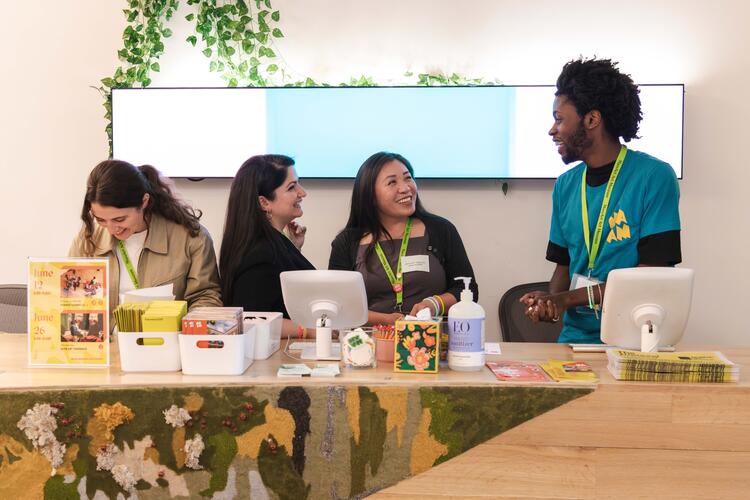
MassArt Student and MAAM Staff checking folks in at an event.
This reciprocity has been on my mind while preparing for Press & Pull: Two Decades at the Robert Blackburn Printmaking Workshop. The exhibition explores the history and impact of the Printmaking Workshop (PMW), founded by Robert Blackburn in 1947. Blackburn, an artist and educator, deeply understood the essential connection between artists and community. The community that Robert Blackburn established through this workshop shifted the understanding of the artist as a singular entity, self-reliant and self-sustained, and changed the history and practice of printmaking for generations to come. As a center of collaboration and creativity for printmakers of all experience levels, the PMW expanded opportunities – particularly for marginalized artists – to experiment with printmaking, refine their artistic practice, and work within a community of makers.
Community of Makers
At MAAM, we strive to cultivate a similar environment for students, a community of makers. As a teaching museum, MAAM educates and empowers the next generation of artists, educators, and designers. Student employees learn a variety of skills during their employment: students learn how to use tools to install artwork in our galleries, facilitate conversations with visitors, uphold museum policies with care, and collaborate effectively with their peers. They do so while navigating the shifting realities of both museum work and their own college experience, not to mention the constant shifting realities of our current socio-political present. While these skills are valuable as students move toward their chosen career paths, they gain more than just practical skills; students gain an appreciation for the experience of working within an evolving, inclusive community – students teaching students, artists teaching artists.
During their time at MAAM, students participate in regular training and professional development – though more often than not, students experience a great deal of personal growth, as well. Training in gallery facilitation helps them use their voices confidently, while also teaching them the importance of inviting others into the conversation. Learning how to maintain museum policies and communicate them to visitors simultaneously teaches them how to create safe, accessible spaces, how to relay guidelines with care, and how to navigate difficult conversations or differing perspectives with empathy.
These experiences are stepping stones to other opportunities; students who demonstrate interest in learning how to facilitate gallery talks are offered the chance to share their knowledge and demonstrate these skills for their peers at our monthly training. Students who work on our gallery crew often utilize these skills and leadership throughout the MassArt campus, assisting with other gallery installations. Former student employees of MAAM often leave their role with the communication skills and the confidence necessary to advocate for themselves in their professional endeavors, landing entry-level roles at institutions throughout the country.
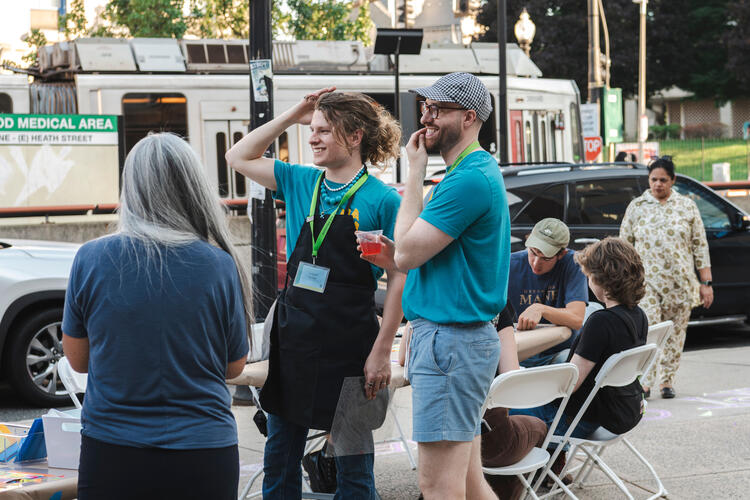
MassArt Student and Staff at MAAM's annual Art on the Plaza event.
Passing it on
New student workers often ask, “What if a visitor asks a question that I don’t know the answer to?” This is my favorite question to answer, and we encourage students to respond with transparency and curiosity: “I don’t know the answer to that, but let’s find out together.” This approach teaches students that uncertainty is acceptable, to encourage curiosity in others, and that working with others to find an answer or solve a problem can create opportunities for dialogue and meaningful connection. Education is a form of empowerment, and change or uncertainty are invitations to seek connection and share knowledge. Our ability to share knowledge and cultivate a meaningful community is a learned skill, and a practice that I hope our students utilize long after they leave the museum.
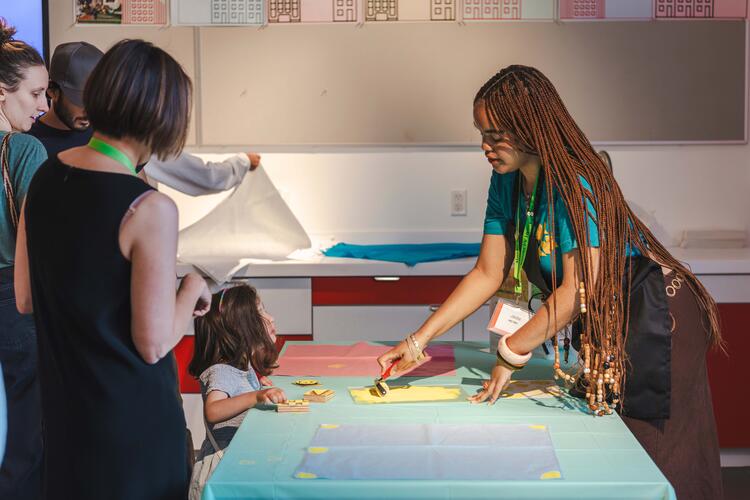
MassArt and MAAM Student showing printmaking techniques to a young artist.
I’ll leave you with this: in anticipation of our exhibition openings, I recently studied the companion booklet for Press & Pull, which features essays by Ethel Renia. In an excerpt demonstrating what Blackburn’s community building can teach us, Renia articulates the type of community we strive to offer and cultivate for students at MAAM:
His Workshop shows us that sustainable artistic ecosystems are built not on competition, but rather on collaboration, generosity, and trust. It reminds us that spaces where artists can experiment without fear—regardless of fame, resources, or identity—are not luxuries, but necessary in the pursuit of strong, interesting art. Most of all, Blackburn teaches us that the most enduring legacy isn’t found in personal glory, but in the communities we nurture and the doors we hold open for others.
– Ethel Renia, A Place Where Something Shines: Robert Blackburn’s Printmaking Workshop and the Legacy that Endures.
Discover | Connect | Support
- Read more MAAM Stories.
- Learn more about opportunities for college students at MAAM.
- Explore Our Exhibitions | Discover more about our current, upcoming, and past exhibitions.
- Get to know MassArt better, the nation’s only public independent college of art and design.
- Support our mission.
- Say hello! Contact us as maam@massart.edu.